

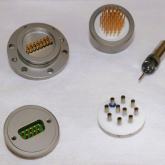
Glass-to-metal hermetic feedthroughs and connectors
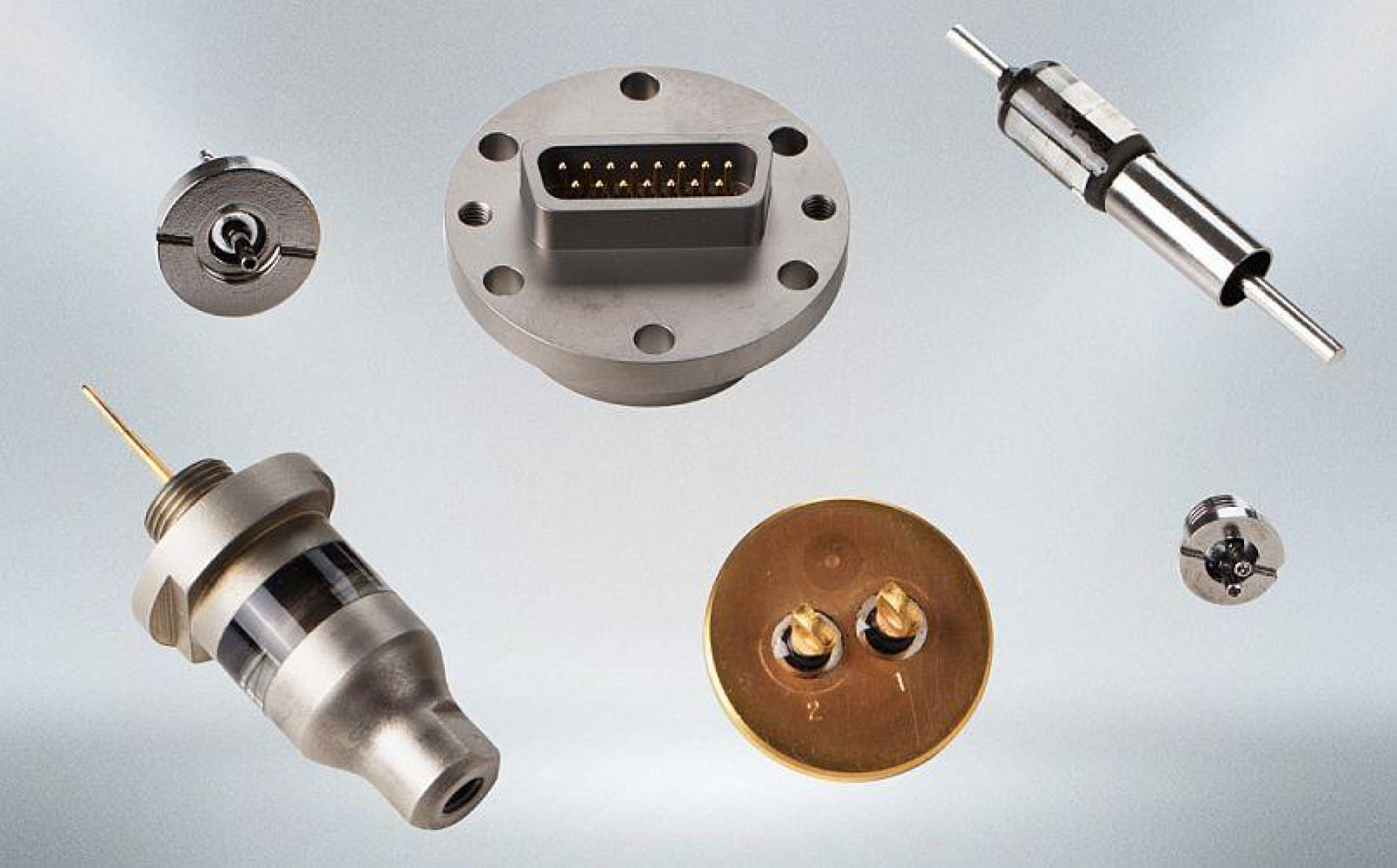
From single-pin feedthroughs to multi-pin connectors, CTVM designs and manufactures glass-to-metal hermetic assemblies whose primary function is to provide electrical continuity between atmospheric and high-vacuum environments, while ensuring insulation and hermeticity.
These products are built using glass and metals such as Kovar (Fe-Ni-Co alloys), molybdenum, Inconel, or 316L stainless steel. For filament blocks, for instance, ceramic will also be integrated.
MORE INFORMATION
Our glass-to-metal hermetic feedthroughs and connectors are used in applications such as high and ultra-high vacuum instrumentation, aerospace and submarine interconnects, electronics, and energy.
They are particularly suited for severe environments involving high vacuum, pressure, and high temperatures.
Examples of applications include:
- embedded electronics for civil and military aerospace,
- defense equipment,
- analytical and medical instrumentation,
- particle physics,
- high and ultra-high vacuum,
- energy ….
From single-pin feedthroughs to multi-pin designs, CTVM manufactures glass-to-metal connectors or ceramic-to-metal filament blocks based on a sealing glass and an associated metal.
The list below is not exhaustive, as most of our work involves customized glass-to-metal assemblies. Examples include:
- high-voltage feedthroughs for mass spectrometry and electron guns,
- hermetic high-voltage and/or high-pressure and/or high-temperature connectors for the energy industry,
- glass-to-metal gun envelopes for electron tubes,
- hermetic feedthroughs for embedded sensors…
CTVM also offers several standard high-voltage glass-to-metal feedthrough models.
Magnetic versions are made with a Kovar (Fe-Ni-Co alloy) sleeve and conductor.
Non-magnetic versions can be produced with a stainless-steel sleeve and a molybdenum conductor.
Two families of standard feedthroughs are available:
- Type 102 – Insulation > 10¹² Ohms, dielectric strength 10 to 20 kV, sleeves Ø 6–8–10 mm, conductors Ø 1–2 mm
- Type 103 – Insulation > 10¹⁰ Ohms, dielectric strength 2 to 15 kV, sleeves Ø 4–5–6–8–10 mm, conductors Ø 1–4 mm
In the design of a glass-to-metal seal, selecting the appropriate glass and metal is the most critical factor.
The most commonly used glasses include electronic-grade glass (Schott 8250) and specific sealing glasses from the borosilicate and soda-lime grades.
The metal directly associated with the glass must have a closely matching coefficient of thermal expansion to limit residual stresses that could compromise hermeticity.
The most widely used metals and alloys include Fe-Ni-Co alloys (Kovar, FN48, FN52…), molybdenum, and stainless steel.